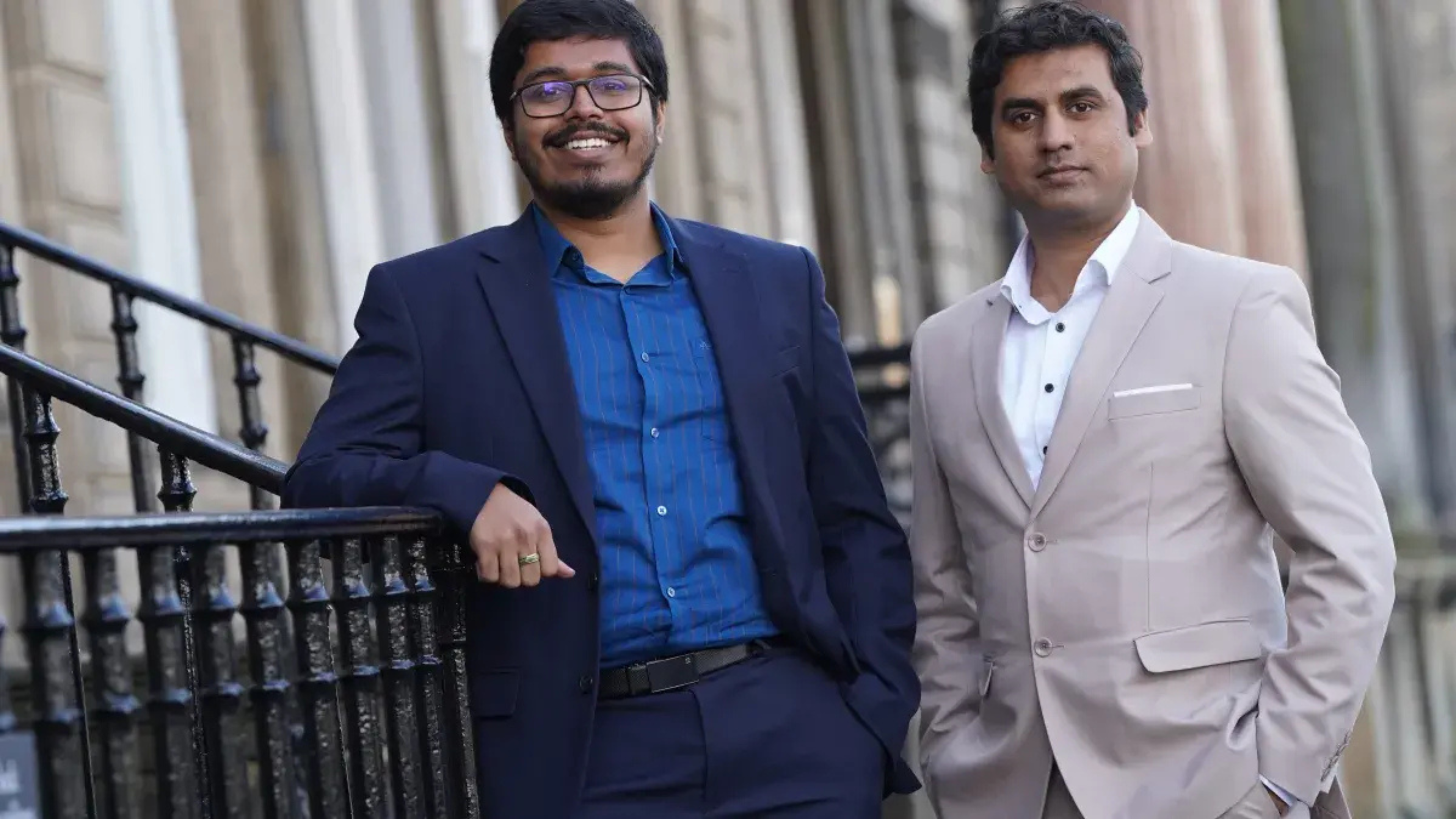
Scensai is developing AI-powered “electronic nose” technology capable of detecting and analysing chemical changes in real time, with applications ranging from brewing and distilling to food safety and manufacturing. Through the Venture Builder Incubator (VBI), founders Dr Ammar Elhoweris and Dr Marcus Bannerman refined their commercial focus, built industry connections and gained valuable insight into turning cutting-edge research into a scalable venture. The programme helped the team move from a promising technical concept to a clearer commercial pathway, culminating in increased investor and industry interest following the VBI showcase.

Venture Builder Incubator
70
.jpg)
Venture Builder Incubator empowers aspiring founders from Scotland’s universities to start or grow their tech business. Bridging the gap between research and entrepreneurship, Venture Builder Incubator gives you the tools, skills, and support to transform your deep tech or data-driven idea into a thriving startup. Through our ongoing partnership with Cancer Research Horizons, the Venture Builder Incubator provides tailored support to research staff and academics across the UK developing oncology-related data-driven innovations.
Scensai’s technology is known as an “electronic nose”. If you’re wondering what that is, co-founder Dr Ammar Elhoweris explains it like this.
“Thanks to AI and cameras we can now detect people and objects like cars. Our ENose brings that into chemistry, detecting leaking whiskey from a barrel or a fermentation that’s complete. Like Shazam for music, we bring scent to AI at Scensai.”
Electronic noses are not new technology, but what sets Scensai’s apart from others is its ability to transfer learning between devices. Most systems need to be individually trained because of environmental conditions, sensor variations and other external factors which mean one device cannot easily share its data or calibration with another.
Scensai believes it has solved that challenge by enabling each device to teach every other device on the network. In practical terms, this means a single trained device can be replicated and deployed at scale, dramatically improving consistency and commercial viability.
Capable of producing lab-quality chemical analysis in seconds, the technology is being used for brewing and distilling quality control where sensory judgement is often highly skilled but still subjective, with trials taking place with an Aberdeen-based brewer.
“I think almost every industry could benefit from chemical sensing. All our amazing digital infrastructure can see and listen with cameras and microphones but cannot tell you directly if that food is safe, or if there’s contamination. A cost-effective chemical sensor can unlock all of that and potentially much more,” said Dr Marcus Bannerman, Ammar’s fellow co-founder.
But as promising as their initial idea was, the commercial pathway was unclear.
Marcus explains: “I knew we had great technology, but I didn’t know who might want it, or even why. I think many industries could massively benefit from some affordable chemical sensing, but we needed to test this. We joined the Venture Builder Incubator (VBI) to try to figure out who had the most urgent need, widest market and shortest path to market for us.”
For Ammar, who had just returned to Scotland after years in various senior roles in Qatar, VBI seemed the obvious starting point to build a new network, but he wasn’t initially convinced.
“I came in thinking I already knew what building a business looked like. Doing it in practice is a completely different thing.”
That shift, from thinking about a business to actively working on one, is exactly what VBI is designed to support.
One of the biggest changes during the programme was the team’s growing clarity around where to focus first.
“We went from whisky authentication to brewing quality control around halfway through VBI, once we started having more real market conversations,” said Ammar.
And when the founders talk about what proved most beneficial in VBI, both point to the people and conversations they encountered during the programme.
“The coaching calls were extremely useful. Deborah Wood from Ascendit held a mini workshop looking at a value proposition canvas. She showed us what we were doing wrong and how it should be done and it completely changed our minds on how we thought about the framework,” said Ammar.
“And our meeting with Richard Lennox, the entrepreneur in residence and a former director at Skyscanner, was fascinating. The way he thinks is very different. Coming from an IT background he immediately homed in on one aspect of our business model and we’ve been thinking about what he said ever since.”
Marcus adds: “The fireside chats with successful entrepreneurs was absolutely fascinating for me as an academic, as I could see aspects of myself in each of them. This helped me draw parallels to my own journey and made me realise how much I still had to learn but also how achievable it was.”
And the programme helped build confidence and momentum for the founders as they progressed through the different stages.
“I'd spent several years in senior roles abroad, and when I came back to Scotland there was naturally some work to do in terms of building up my local network again. The network of advisors and connections you get through VBI was invaluable for that.” says Ammar.
He says the process of repeatedly speaking to people, testing assumptions and putting himself in front of others helped build his confidence as a founder and strengthened his belief in the business.
“When you're building something from nothing, there's nowhere to hide. The VBI programme forces you to keep putting yourself and your ideas in front of people, and that process builds confidence faster than anything else I've come across.”
In addition, the connections the pair made through VBI proved valuable beyond the programme itself.
Marcus says: “It wasn’t only the camaraderie and peer-support but we also connected with the National Manufacturing Institute of Scotland (NMIS) through another founder in VBI and they’re being very helpful.”
Ultimately, VBI did not just give Scensai information. It gave the founders access to people, perspectives and conversations that helped sharpen their thinking in real time. That kind of 360-degree support and momentum-building is central to the programme’s wider purpose.
“After the showcase, investors wanted to hear more and international industry contacts got in touch. People were excited about what we were building,” said Ammar.
When asked what he would say to other founders wondering whether a programme like VBI is worth the time, Ammar’s answer is ultimately about accountability and progress.
“I read an essay by Paul Graham from the Y Combinator accelerator where the point is that effort doesn't scale linearly. VBI gave me a structure that forced me to show up every week, and that effort compounds in ways you don't notice until you look back.”
Marcus is equally clear in his recommendation for other early-stage founders.
“It was a great crash course on all the aspects of start-up and spin-out activity and helps you find mentors and peers that normalise the sometimes stressful and other times exhilarating experience,” added Marcus.
For Scensai, VBI was not the end of the story, it was the point at which a technically impressive idea began to turn into a real commercial journey.
If you’re at the same stage, then VBI might just be your idea travel companion.
Find out more: Scensai Website

.webp)

.webp)

.webp)
.webp)

.webp)
.png)
.webp)


.webp)



.webp)
.webp)
%2520and%2520UofE%2520Business%2520School.webp)
%2520and%2520the%2520Usher%2520Institute%2520(1).webp)
.webp)
Bayes Centre, 47 Potterrow, Edinburgh, EH8 9BT