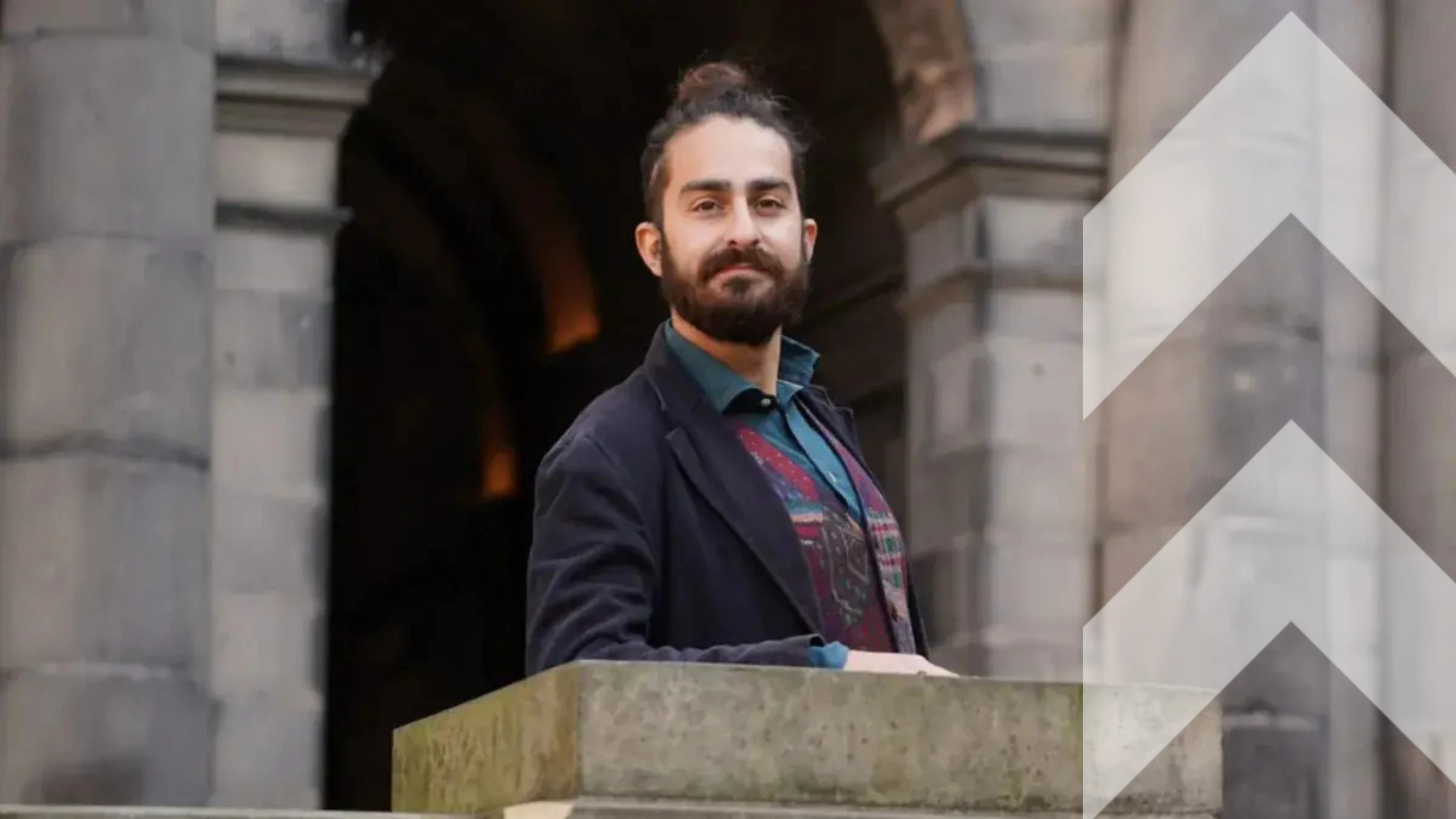
We spoke with Dimitrios Doudesis, a DDI Fellow, about his journey in creating CoDE-ACS, an AI-driven clinical decision support tool, and his experience in the DDI Fellows programme.

Data Driven Innovation Fellows
DDI Fellows 2025
.webp)

The Data Driven Innovation (DDI) Fellows Programme supports academic and professional services staff at the University of Edinburgh to explore and develop spin-out or startup ventures.
When Dimitrios Doudesis first moved into health data science, he knew he wanted his work to have a direct impact on patient care.
“I wanted to do something good,” he says. “I wanted to do something that would positively affect patients’ lives.”
That ambition is what drew him towards applying statistics and data science to medicine. After studying statistics in Greece and completing a master’s degree in medical statistics at the University of Southampton, Dimitrios moved to the University of Edinburgh to undertake a PhD in data science and precision medicine.
It was there that the foundations for CoDE-ACS were laid, an AI-driven clinical decision support tool designed to help clinicians diagnose heart attacks more quickly and accurately. The Data-Driven Innovation Fellows Programme (DDIF) helped Dimitrios further explore the commercial and translational pathway for CoDE-ACS.
To understand the problem CoDE-ACS is trying to solve, Dimitrios started with a reality facing emergency departments every day.
Around one million people present to UK emergency departments with chest pain each year. However, only around one in ten of those patients are actually having a heart attack.
The challenge for clinicians is determining who needs urgent cardiac treatment and who can safely go home.
At present, one of the key tools used to make that decision is a blood test measuring a protein called troponin, which is released when the heart muscle is injured due to a lack of oxygen during a heart attack. The issue, however, is that troponin levels are influenced by many different factors, including age, sex, kidney function and medical history.
Current guidelines still rely largely on a single threshold value.
“One solution to fit everybody is not optimal,” Dimitrios explains.
That is where CoDE-ACS comes in. Using machine learning trained on data from around 50,000 patients in Scotland, the algorithm analyses multiple factors simultaneously to calculate the probability of a patient having a heart attack. Rather than replacing clinicians, the system is designed to support decision making, helping doctors identify higher-risk patients earlier while safely ruling out others more quickly.
“We take all the information clinicians already have in front of them and use it together,” he explains.
By the time Dimitrios joined DDIF, CoDE-ACS was already relatively advanced compared to some earlier-stage projects in the cohort. However, the programme provided an opportunity to better understand the next steps involved in translating academic research into a viable product.
“Going from research to actually having a product, there are a lot of steps in the middle,” he explains.
“These are not steps that a classic academic environment can offer without initiatives like DDIF.”
The programme provided support around networking, commercial strategy and spin-out development, while also connecting founders working at different stages of the process.
For Dimitrios, one of the most valuable aspects was simply having space to revisit and strengthen his understanding of the commercial landscape around academic innovation.
“The programme was valuable because it gave me the opportunity to step back from the research and think more clearly about the commercial, regulatory and implementation pathway” he says.
The experience also reinforced something broader about the role universities can play in supporting innovation.
Dimitrios believes programmes such as DDI Fellows are increasingly important in helping researchers pursue translational and commercial opportunities without necessarily leaving academia behind.
“We’re in a world where we have AI, data and so many translational and commercial opportunities,” he says.
“Having these initiatives will help academics stay longer and pursue those opportunities.”
The impact of Dimitrios’ technology could be significant both for patients and the wider NHS.
Patients who are not having a heart attack could potentially avoid spending unnecessary hours waiting in busy emergency departments, while those at higher risk could receive specialist cardiac care sooner. Dimitrios and his colleagues have already published findings in the journals Nature Medicine and Circulation showing the algorithm performs substantially better than current approaches.
Importantly, CoDE-ACS has never been a solo effort.
Dimitrios is keen to emphasise the collaborative nature of the project and the role played by his long-term clinical partners, including Professor Nicholas Mills and Dr Ken Lee, who have worked alongside him since the beginning.
“You need a cardiologist and a data scientist,” he says. “I would never be able to work alone on that.”
That combination of clinical and technical expertise sits at the centre of the work. Dimitrios describes his PhD programme in precision medicine as an attempt to bridge the gap between clinicians who understand the medical problems and data scientists who have the technical tools to help solve them.
After finishing with the DDI Fellowship, Dimitrios is now working with Edinburgh Innovations, the university’s commercialisation service, as the project moves closer towards potential spin-out activity and eventual deployment within healthcare settings.
There is still work to do before CoDE-ACS reaches hospitals in a live clinical environment. Regulatory approval, testing and medical device certification remain important next steps.
However, the project remains rooted in the same motivation that first drew him into health data science almost ten years ago. Using data not simply to generate research, but to create something that could genuinely improve people’s lives and ease pressure on the NHS.


.webp)

.webp)

.jpg)
.webp)
.png)
.webp)





.webp)






.webp)
.webp)



%2520and%2520UofE%2520Business%2520School.webp)

%2520and%2520the%2520Usher%2520Institute%2520(1).webp)
.webp)
Bayes Centre, 47 Potterrow, Edinburgh, EH8 9BT