EOLAS Insight uses drone imagery and 3D digital twins to monitor puffin burrows, working with the University of Edinburgh's School of GeoSciences. Based at the Bayes Centre, the company blends AI with conservation expertise — while keeping human judgement central to the work.
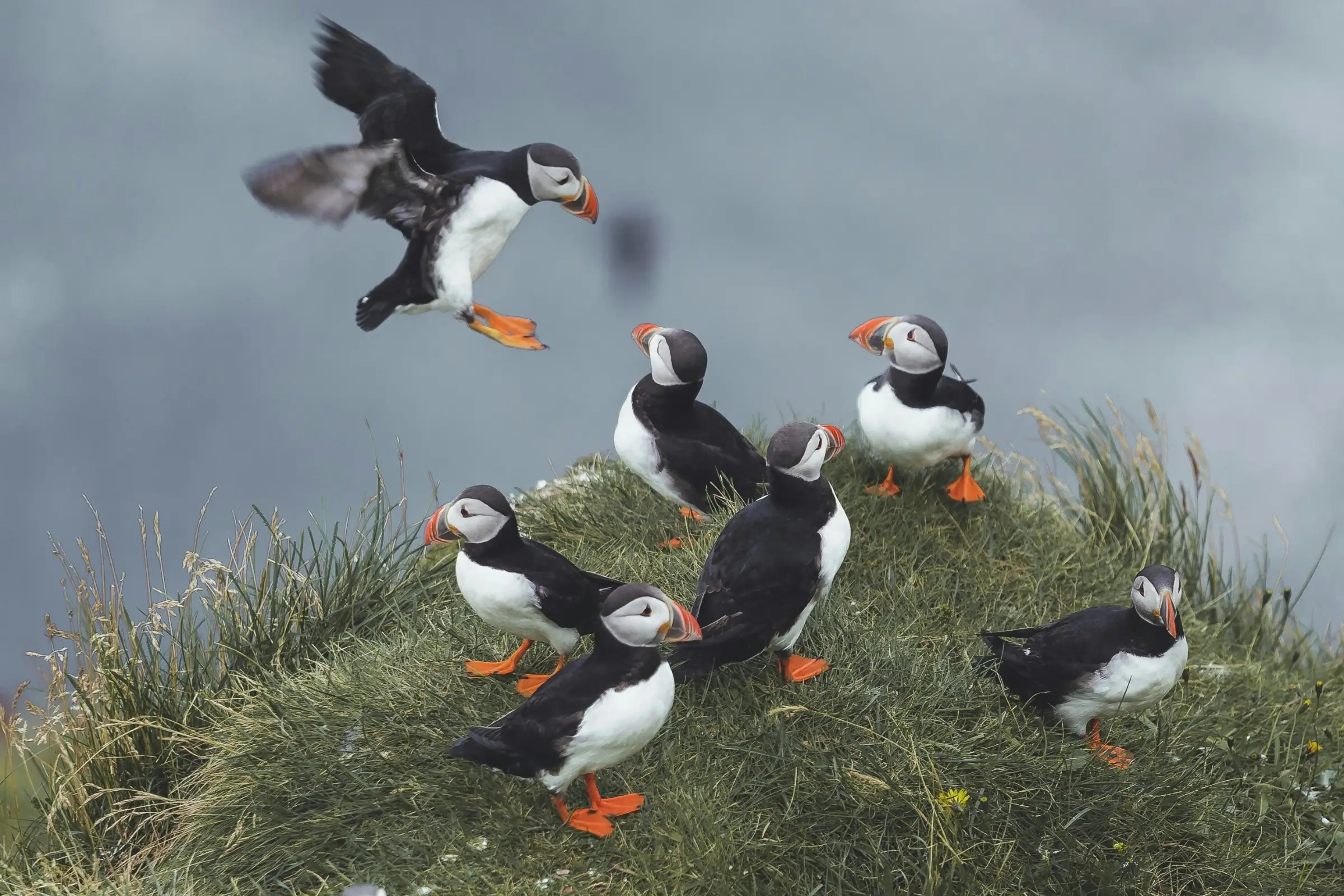
For years, conservation work has depended on patience, boots on the ground, and knowledge passed down through decades of fieldwork. In this context, counting a puffin colony often means sending people out with binoculars and notebooks, frequently to places that are remote, difficult, or dangerous to access. EOLAS Insight is working in partnership with the University of Edinburgh to help address this challenge, bringing together geospatial science, remote sensing, software design and AI. Through its base at the Bayes Centre, the University's innovation hub for data science and AI, EOLAS Insight benefits from proximity to researchers, shared facilities, and opportunities for collaboration.
The company was founded on a simple observation, that advanced technologies can help us protect and restore nature. That observation has helped shape the company's work on its Seabird Monitoring Platform and one of its most ambitious projects to date: improving puffin monitoring in Scotland in close collaboration with the University's School of GeoSciences.
Puffins are notoriously difficult to monitor. Unlike many seabirds, they nest underground, making it challenging to determine whether burrows "are being used and breeding is successful," says Dr Amy Tyndall, Project Lead. The project traces back to CivTech Scotland, a government innovation programme that identifies societal challenges and invites innovative solutions.
NatureScot and the National Trust for Scotland brought forward the challenge of improving seabird monitoring, beginning with puffins because, as Amy explains, they are "one of the hardest seabirds to count."
Data collection is carried out in collaboration with the University of Edinburgh's School of GeoSciences. The University's Airborne Research and Innovation facility conducts drone surveys over priority colonies, producing an orthophoto, i.e. one large, stitched image of the colony. From there, the team creates detailed 3D digital twins of the sites, where "people can view the colony in full 3D, zoom in and out, and move around it," explains Amy. These models make burrows far easier to identify and monitor at scale.
Alongside this, EOLAS Insight's data science and technology teams are developing machine-learning approaches to identify occupied burrows automatically. By building a growing picture of what an occupied burrow looks like, the system can learn to recognise indicators such as "gardening" behaviour, where puffins clear vegetation and leave patches of bare earth around burrow entrances, elaborates Amy.
That technical foundation extends beyond a single project. EOLAS Insight's presence at the Bayes Centre has been instrumental in developing the company's capabilities and partnerships. The collaboration is driven as much by people as it is by institutions, bringing together researchers, students, and industry partners from across the University. Amy's own route into the company began with her MSc dissertation in the School of GeoSciences, supervised by Dr Caroline Nichol, using aerial imagery to assess the impacts of the 2022 avian influenza outbreak on the gannet colony at Bass Rock. That work fed directly into the development of the seabird monitoring platform that EOLAS Insight is now bringing to conservation organisations.
The University of Edinburgh's Airborne Research and Innovation facility at King's Buildings provides drones, pilots, and specialist instrumentation that the company does not currently hold in-house. At the same time, University staff are contributing to the development of guidance for drone-based seabird surveys, helping ensure future surveys can be carried out consistently and that long-term monitoring datasets remain comparable.
Talking to both Amy Tyndall, the Project Lead and Sarah Daniels, Cartography and Creative Lead at EOLAS Insight, about their technology and the ideas that underpin it, they continually emphasise that their vision is not to sideline the ornithologists and ecologists who hold the expertise.
"There is never a single technology that solves everything," says Sarah. "It is always a combination of multiple technologies plus human input, expertise, and judgement. The human touch is always going to be needed."
The shift in thinking that EOLAS Insight represents is not one of machines taking over from people, but of the field notebook finding a digital companion. Drones and algorithms now do counting that once consumed entire seasons, while ornithologists still supply the judgement that gives the machine-collected data real meaning. Upon being asked what they hope the project ultimately achieves, Sarah did not reach for a metric: "Even though we are tech people, we are in it for nature. Humans are the ones who have always meddled with nature, and they will always be the ones who can make it better or worse, and we want to support the people trying to make it better." It's an ambition that starts, fittingly, at the Bayes Centre — the kind of place built to turn ideas like this into something workable and then let them go on to do good in the world.
Bayes Centre, 47 Potterrow, Edinburgh, EH8 9BT